Dad's Rules Revisited
This is a "living document" unlike the 10 Commandments and the Constitution. If you show me the rule is wrong, unfair, and harmful I will listen.

This is a message to my children I am hoping may be a helpful guide to anyone else who may need it. I am not overestimating the reach of this Substack but I do believe anything put out in a way anyone can access it has the chance to make some impact, whether it becomes realized or remains as potential in perpetuity. In any event, writing this down with the knowledge it CAN be seen by others helps me get my thoughts in order and values aligned, so thank you for being the potential that helps me be better for my children.

It is far better to render Beings in your care competent than to protect them.
- Jordan B. Peterson
This is the original from November 9th, 2022 (2 likes, yall). I have been dealing with some things in my personal life. I lost my job and I’m attempting to save my house, in short.
Thusly, while I have felt the pull to write, I haven’t been able to drag myself to something I can use to do it.
Except that’s not completely true. I have been on my computer, but I haven’t been able to get myself to write.
Except that’s not completely true either. The idea that one “cannot make oneself” do “x task” is bunk. I didn’t make myself. I chose to do other things. I lied to myself about why at times. Other times I was completely cognizant of the avoidance taking place.
So what I am going to do now is promise TEN pieces in TEN days. This is day one and we’ll start with revisiting an old piece that I loved writing yet hated seeing published.
The original intent was a list of rules, though some other authors have done that already and been wildly successful.
I do love the idea, however. Rules are important anyways.
So today the idea is to revisit the piece, leave it mostly intact and just add on.
There will likely be some commentary littered in as well.
1. Do not lie to me
Past me was smart for this one. It still remains as rule numero uno.
It’s not a good idea. I will find out. It may not be right then, it may not be tomorrow, but it will come out. Keep in mind I make my decisions when it comes to my kids on the basis of teaching (where I can). This means I may know right away and allow you to think you got one over on me. I try to avoid doing this trick, and it is definitely a trick, but there are circumstances where I believe it’s necessary or would be more beneficial as a lesson later.
For example, if we’re rushing to get out the door because we’re late for one of your sibling’s doctors appointments I likely won’t have the time to get you to admit anything at that point. Make no mistake in this situation, however, I will circle back later.
Don’t inadvertently call me stupid. Hopefully I can make this argument intelligible (why lying is calling someone stupid). When you lie to someone, you’re basically saying “Either I am intelligent enough to fabricate a reality that you cannot see through.” or “You’re too dumb to see through this thin veil of manipulated truth. EVER.” Likely it’s both.
I know you’re just scared. It’s okay to be scared, but try taking responsibility or owning up to something you’re afraid of admitting. It won’t be as scary as you thought, though there will be consequences as with everything. I know how hard it is to take responsibility, so you can bet admitting something will be considered a mitigating factor with me. I am not in the business of punishing mistakes (unless you count my lectures as punishment, which is fair). Give me a chance to understand your situation and likely the encounter will end in nothing more than a chat.
There’s more to this issue of lying to me than what was originally conveyed. I’m sure my intent was to hit on the overarching points and circle back later, but my writing tends to have a more… doodley path than a circular one.
When you lie you warp your own perception of reality. When you lie, you must lie again to keep up the original. Over time this warps reality—your reality—beyond our ability to fix it with any safe corrective action. At some point you will fall. You will need to fall. The whole thing must come crashing down for correction to take place.
This doesn’t tend to happen voluntarily. It’s one of the many perils of lying in general. Having a warped reality means you cannot see what is actually around you. If you’re going through hell and you’ve told yourself and everyone around you it’s all sunshine and rainbows, you’ll start seeing sunshine and rainbows.
This means as you’re chasing the end of one rainbow, you’re going to end up falling off a cliff into the lava-fall you imagined was holding a pot of gold at the end.
1. Do not lie to yourself.
Don’t make excuses for poor decisions, take responsibility. If there’s an excuse for every bad outcome for every bad decision, those decisions will continue to be made. For instance, if you catch the house on fire because you put food in the microwave still wrapped in tin foil, take away the knowledge that tin foil doesn’t go into the microwave.
If you come up with an excuse like “It should have told me on the packaging that this tin foil doesn’t go in the microwave, this isn’t my fault” then the chances you’re going to set more fires due to not thinking or being careful are much higher than if you decide to be safe going forward and pay attention to what you put in.
You shouldn’t rely solely on immediately available warning signs to keep you from making poor decisions, you should rely on your current knowledge and common sense as well. Not every mistake made because consequences weren’t listed in a visible place or the warning signs were ignored are recoverable or potential learning experiences.
Grilling inside, for instance, isn’t something you can walk away from. Generally this is one mistake you can only make once. Be truthful to yourself so you can continue to accumulate knowledge and experiences that will help you avoid potentially disastrous mistakes in the future.
If you lie to yourself you also run the risk of continuing on a trajectory in life that is not meaningful and isn’t good for you. Keep your compass calibrated.
This one is insidious. It's harder to spot because you want to believe yourself. That makes it more dangerous than lying to others.
You’re poisoning your own food.
Let’s say you’re in a job you hate, but you keep telling yourself, “It’s not that bad,” or “Everyone feels like this.” That might feel like comfort, but it’s a slow death. You’re trading away your time (read:your life) under the illusion that you’re being practical or mature. But there’s nothing mature about selling your soul by installments.
Don’t get this confused with working to provide, either. If a family is to be supported, it must have a support. Work leads to reward, though the reward tends to vary. Work can be tending your land and livestock with the reward being shelter, food, and safety. It can also be data entry with the reward being money.
Either way you’re working for the end goal of supporting and providing. Even in a dead-end job there is meaning there. There is purpose. If necessary, hold onto that while you find out who you are and what you can do to provide and not risk being miserable.
But if you’re working only because you think you’re supposed to in a job that’s destroying you, don’t lie to yourself.
Back to self-poisoned entrees… The antidote is brutal honesty. You might hate where you're at, but at least say it out loud. “I hate this.” Say it, own it, then ask: “What can I do about it?” This begins agency and that’s what brutal honesty gets you.
When you lie to yourself, you build your life on sand. The moment life sends a wave, it all comes crashing down and you’re left wondering how it all fell apart so easily.
3. Your best effort is required for everything you set out to do.
This one likely needs to be broken down quite a bit more than this one simple statement, and it will be. For now I will attempt to explain it more succinctly than I would generally prefer. Nobody wants to read a novel when they’re expecting an essay.
The purpose of this rule seems obvious and probably is. Trying your best will get you better results in any task or challenge undertaken. Trying your best in your career will take you much further than if you had phoned it in instead because you didn’t want to give much effort. But why is it important to try your best at everything?
You are capable of far more than you currently realize. This statement will be true at every point in your life so save it and read it often. When you are 180 years old, after you discovered the secret to extending human life, after you had two concurrent and successful terms as president and an encore of your presidency was requested worldwide, after you solved world poverty and hunger simultaneously this statement will still be true.
During each step of your journey you could not have known you were capable of the next one. Do not prematurely end your journey due to half-assing something that you should have whole-assed. While I am around and able to be aware of what you are doing and the effort you are putting forth, I will be giving MY best effort to ensure you give YOURS.
I will be annoying at times and I will seem mean and harsh at others but you will understand when you have children of your own. When you see children out in the wild, let’s use Wal-Mart as an example, you just see a child. A boring, regular child that you’re likely inclined to avoid because they’re either snotty, gross, or have a high chance of being annoying.
It’s easy to think that having one of those goblins is undesirable when you are younger. Once you “accidentally” create one of your own that perspective changes drastically. You will see limitless potential in that snotty, gross, screechy and sometimes annoying perfect angel of a human burrito you hold in your arms (though at Wal-Mart they will look like a goblin to everyone else).
You will want to give them the best possible opportunity to see the potential you felt in them. You will understand the desire of the parent to sacrifice for the child. It may not make sense how I can be confident in this eventuality but I submit not everything has to make sense to be true.
Habits are formed and broken when you aren’t paying attention. This isn’t true all of the time, but it is the majority of the time. You can develop habits on purpose but of course that takes effort. Developing good habits by virtue of being responsible and doing things you know are good is a better way. We can call that developing good habits inadvertently.
If you consciously put forth your best effort in everything you do and you live your life according to the morals you subscribe to it will eventually become, oddly enough, effortless. This brings me to the final point (though no less significant than the others).
The most difficult part of doing your best isn’t the task itself or the effort put in, it’s the initial decision. Make the decision not to slack off and if you feel yourself slipping, make the decision to reorient yourself to putting forth your best.
If you hit a wall and can no longer put forth your best effort, take a break and continue on later. Do not confuse performance with effort. Performance will vary often depending on circumstances. Variables like muscle fatigue, eye strain, stress, health etc affect performance. Just make sure you are doing the best you can with what you have to work with.
Let’s add something here: your best effort today might look very different from your best effort last week.
Perfection is unattainable, progress is the point.
Maybe your best effort today means showing up when you really want to quit. Or maybe it’s holding back when you want to lash out. Sometimes your best effort isn’t visible to anyone but you. That doesn’t make it any less meaningful.
There will be days you fail. You’ll fall short of what you wanted to do or who you wanted to be. That’s not a reason to abandon the principle. It’s a reason to double down on it. When you fail, let that be your reminder to recommit, not retreat.
Trying your best isn’t always fun and it certainly isn’t always satisfying. Sometimes it’s fucking terrifying. When you’re in front of friends, let’s say, and you’re a teenager. Passion for anything is, as the kids these days say, “an exhibition of utmost social mortification.”
Now while you’re in front of your teenage friends as a teenage person there comes a time where you encounter something you enjoy. Let’s say dancing.
Except your peers are there and you cannot show joy for some reason. Only, your super old and totally cringe Dad has always told you to do you, to do what you do, what you are, and to not give in to those weird coming-of-age social woes. He also says, to your annoyance, to give your all in everything you do.
Just one time phoning it in wouldn’t be the end of the world, would it?
No, likely not. But if you give in now, kiddo, good luck not giving in the next time.
There’s a reason this is rule three. Not putting your all into what you do is quite similar to lying. It’s a slippery slope. If you give yourself an out now, you’ll do it later. Trust me.
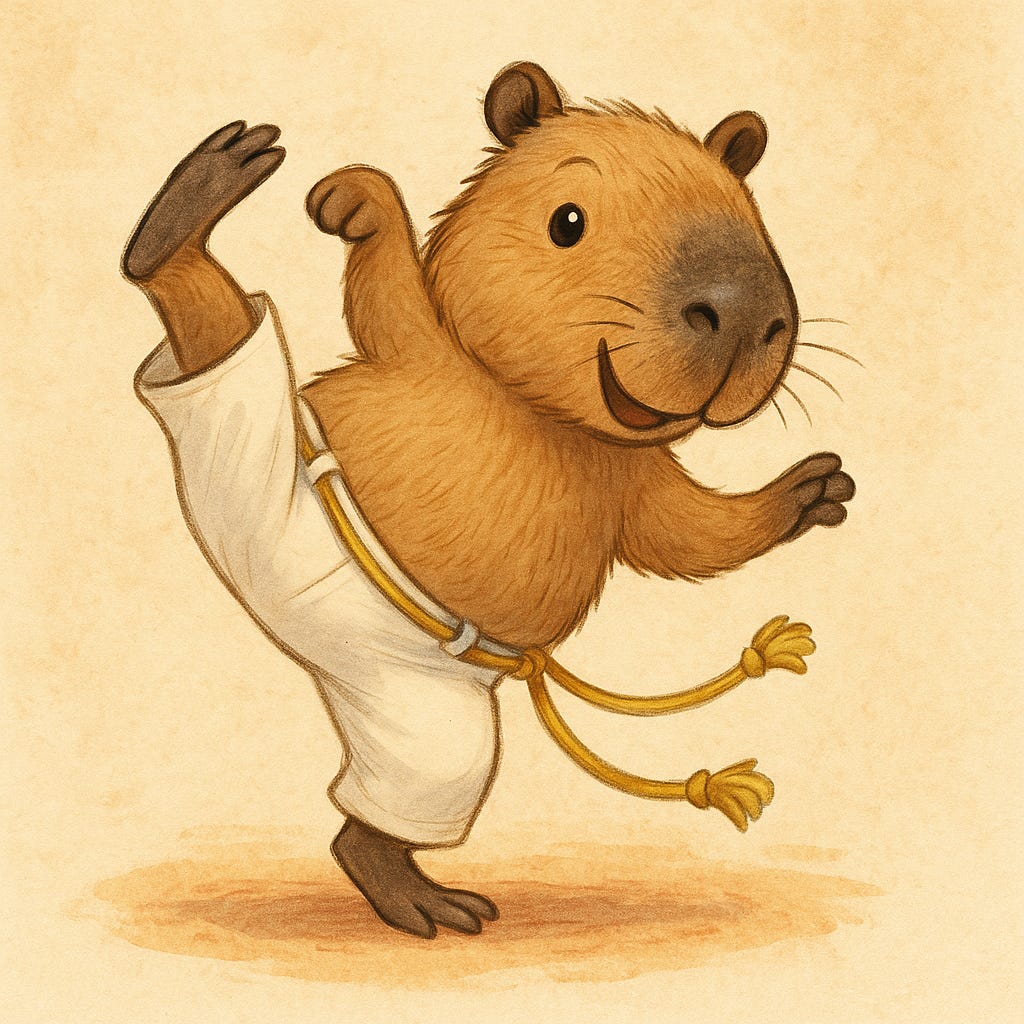
Go take on that terrifying dragon called teenage social angst. Kick it in the ass while you dance your heart out. Hell, there are martial arts that mix dancing with beating the hell out of fools. I think it’s called Capoeira or something.
Not to be confused with capybara.
Though that would be ADORABLE.
Pic for reference: